
Linger Spaces: How Designing for Connection at School Sites Can Attract Families to Lodi
Every city in the Central Valley is trying to solve the same problem: how do you get young families to move here — and stay?
The conventional playbook is economic development incentives, housing starts, and marketing campaigns. These matter. But they miss the thing that actually makes families choose a community and put down roots: the feeling that they belong somewhere.
What if Lodi's school sites — the places where families already show up twice a day, five days a week — could become the infrastructure for that belonging? Not through programs or committees, but through the physical design of the spaces in front of the school?
I'm calling this concept Linger Spaces.
The Insight: Relationships Don't Form in Parking Lots
Here is what most school campuses look like at drop-off and pick-up: a line of cars, a chain-link fence, a concrete apron, and a bell. Parents pull up, kids get out, parents leave. The entire experience is engineered for throughput, not connection.
Now consider what we know about how meaningful relationships actually form. Jane Jacobs, writing in The Death and Life of Great American Cities, described how the trust of a city street grows from many small, seemingly trivial public contacts — stopping to chat, nodding hello, comparing opinions. She argued that the sum of these casual encounters is not trivial at all. It becomes a web of public respect and trust, a resource in times of personal or neighborhood need.
The writer Simon Sarris has extended this idea into a modern frame. He argues that community is always the product of someone's effort, and that the pathway to deep relationships runs through repeated, low-stakes proximity — showing up at the same park, the same porch, the same morning coffee spot. The critical ingredient is not a program or an app. It is a place that makes lingering feel natural.
Ray Oldenburg, the sociologist who coined the term "third place," described these as the informal public gathering spots that exist beyond home and work — the coffee shop, the barbershop, the park bench. Third places are neutral ground. You don't need an invitation. Conversation is the main activity. The mood is relaxed. And over time, regulars develop — people who simply show up, again and again, until strangers become neighbors.
I think school sites may be the most underutilized third-place opportunity in American civic life. Every family with children is already there. The schedule is already set. The community is already self-selecting by geography. All that's missing is the physical space that says: stay a while.
What a Linger Space Actually Looks Like
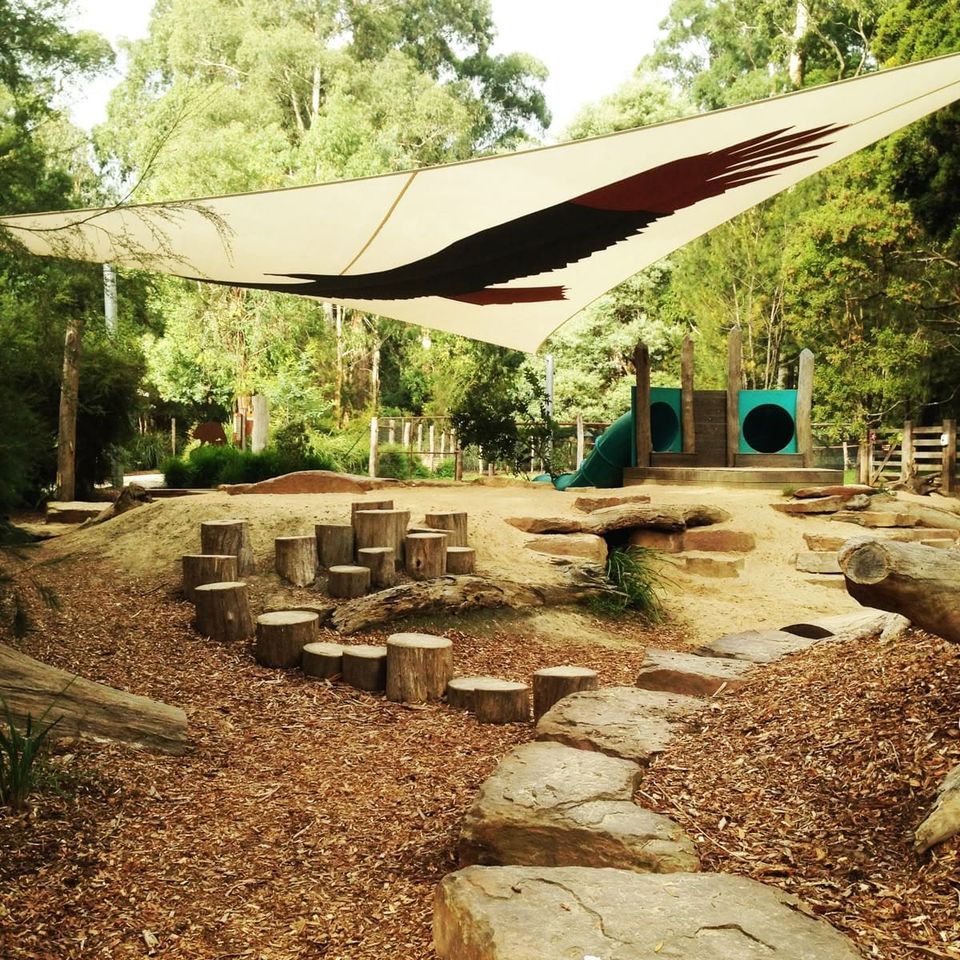
A Linger Space is not a capital-intensive construction project. It is a modest, intentional redesign of the zone between the sidewalk and the school entrance — the threshold space where parents wait, gather, and currently have no reason to stay.
The elements are simple and proven:
Seating that invites conversation. Not a single bench bolted to concrete facing the parking lot. Movable chairs and small tables, the way Bryant Park in New York or countless European piazzas have demonstrated. When people can arrange their own seating, they naturally form clusters. Strangers become conversation partners.
Shade and shelter. A shade structure or mature tree canopy transforms an exposed concrete pad into a place where it is physically comfortable to remain for twenty minutes instead of two. In the Central Valley, shade is not an amenity — it is a prerequisite for any outdoor gathering from April through October.
A pad for mobile coffee carts and food trucks. This is the multiplier. A designated spot — level ground, accessible power, maybe a simple bollard-protected pad — where a local coffee cart can set up at morning drop-off or a food truck can park at afternoon pick-up. The cart gives parents a reason to get out of the car and walk into the space. It gives them something to hold while they stand and talk. It creates a micro-economy that supports local entrepreneurs while activating the space with energy and aroma and routine. The morning coffee cart becomes a ritual. The Thursday afternoon taco truck becomes a tradition. These are the small commercial activations that turn a nice space into a destination — and they cost the district nothing to operate.
Simple play elements for younger siblings. A low climbing boulder, a balance beam, a sand table. These serve a dual purpose: they occupy toddlers and preschoolers, and they create a reason for parents to stay and watch — which means they stay and talk.
Open lawn or flexible green space. Not programmed, not fenced, not scheduled. Just available. A space where someone might throw a blanket down, where kids might kick a ball after school, where a food truck night might draw the whole neighborhood on a Friday evening.
A community-facing orientation. The space faces the street and the neighborhood, not just the school building. It is visually and physically accessible to anyone — not just enrolled families. It signals that this is a community asset, not an institutional perimeter.
The design language here borrows directly from New Urbanism and traditional town planning, where the Congress for the New Urbanism has long argued that schools should function as civic anchors at the heart of walkable neighborhoods — places where the public realm is generous, inviting, and shared.
The Mechanism: How Lingering Builds Community
The theory behind Linger Spaces is not abstract. I think it follows a well-documented chain of social causation:
Proximity creates familiarity. When parents see each other repeatedly in a comfortable setting, they move from strangers to recognizable faces. This is Jacobs's "web of public respect" in action.
Familiarity lowers the barrier to conversation. A nod becomes a comment about the weather, which becomes a question about a child's teacher, which becomes an invitation to a weekend barbecue. None of this requires programming. It requires only that people remain in the same physical space long enough for conversation to happen naturally.
Parent friendships amplify children's social development. When parents become friends, their children's social worlds expand. Playdates happen. Carpools form. Families begin to operate as an informal network of mutual support. Research consistently shows that family-to-family relationships are among the strongest predictors of a child's social-emotional development and school engagement.
Connected families stay. This is the economic development insight that most workforce attraction strategies miss entirely. Families do not stay in a community because of a tax incentive. They stay because they have relationships they don't want to lose. Every friendship formed at a Linger Space is an anchor — a reason to renew the lease, to buy the house, to not take the job offer in Sacramento.
The Workforce Case: Why This Matters Beyond the Schoolyard
I want to be direct about what I think the economic stakes could be.
Lodi, like many Central Valley cities, is competing for young, skilled workers and their families. Employers need talent. The city needs tax revenue and economic vitality. The school district needs enrollment. These are not separate problems — they are the same problem viewed from different angles.
The conventional approach treats these as separate silos. Economic development recruits the worker. The school district enrolls the child. The community hopes the family sticks around. Nobody is responsible for the connective tissue — the relationships that make a new place feel like home.
I believe Linger Spaces could directly address the job-to-be-done of helping new families feel connected.
Consider the experience of a family relocating to Lodi. They know no one. Their child starts at a new school. Drop-off is anonymous — a car line and a wave. The parents go home or to work feeling exactly as isolated as they did the day they arrived.
Now imagine the alternative. The school has a small plaza with shade trees and movable seating near the entrance. A local coffee cart is set up by the gate — the same one every morning. A few parents are lingering after drop-off, waiting for their cortado, watching a toddler on a low climbing structure. Someone makes eye contact and says hello. The new parent comes back the next day, and the barista remembers their order. Within a week, the new parent recognizes faces. Within a month, they know names. Within a semester, they have a community.
I think that experience could be marketable. It is the kind of thing an employer could point to when recruiting a young engineer or nurse or teacher: "The schools here are different. They're designed so your family will actually make friends."It is the kind of thing a real estate agent could show a prospective buyer. It is the kind of thing that shows up in a family's decision matrix right alongside commute time and home price.
And here is the compounding effect I keep coming back to: as more families are attracted to Lodi, the workforce deepens. Employers find it easier to hire. New businesses consider locating here. Students in the district see more career pathways in their own community. The school-to-career pipeline strengthens because the careers are actually here, because the workers are actually here, because their families felt like they belonged.
This isn't a linear cause-and-effect. It's a flywheel. And I believe Linger Spaces could be the low-cost, high-leverage intervention that starts it spinning.
A Differentiator Worth Exploring
I haven't been able to find any school district in California marketing itself on the quality of its physical spaces as community-building infrastructure. Districts market test scores, programs, and facilities. No one seems to be marketing the experience of belonging.
That feels like a white-space opportunity for Lodi Unified. A district that explicitly designs its school sites to foster parent connection and community formation could offer something genuinely new — and genuinely aligned with what young families are actually looking for when they choose where to live.
The message could be something as simple as: Lodi Community Schools — where your family makes friends.
That kind of positioning could differentiate Lodi from Stockton, from Manteca, from Elk Grove, from every other district competing for the same families. And it would do so not through a tagline, but through a physical reality that families can see and experience on their first campus visit.
The Sponsorship Model: Employers as Partners
There's a natural funding question here, and I think the answer might already be in the room.
Every employer trying to recruit workers to Lodi has a direct interest in making the community more attractive to families. A sponsored Linger Space could be a tangible, visible, high-goodwill investment that benefits a company's recruitment efforts while strengthening the community.
The sponsorship could take several forms: underwriting the furniture and shade structures at a specific school site, funding ongoing maintenance of the green space, or co-branding the space as part of a broader community investment initiative. Meanwhile, the mobile coffee carts and food trucks that activate the space create their own self-sustaining economic layer — local vendors pay a modest permit fee, the district gains a revenue stream, and the entrepreneurs gain a guaranteed daily audience of families. The cost per site is modest — far less than a traditional corporate sponsorship of a sports facility or event — and the return is a permanent, daily-use community asset that carries the sponsor's name.
The pitch to employers could be straightforward: "You're already spending money trying to get people to move to Lodi. Invest in the thing that will make them stay."
A Pilot Proposal
I'd suggest starting small — one or two school sites selected for existing community energy and physical feasibility. Each pilot site would receive:
- A community design workshop to gather parent and neighbor input on what the space should include
- A modest physical intervention: shade structures, movable seating, simple play elements, a mobile vendor pad, and landscape improvements
- A one-year observation period to document usage patterns, parent feedback, and any measurable impact on family engagement and enrollment
The pilot would generate the evidence base needed to scale the concept across the district — and the stories needed to attract sponsors, media attention, and new families.
What This Means for the Strategic Plan
Lodi Unified is developing its first five-year strategic plan in over a decade. I think this is a moment worth seizing — a chance to explore an idea that is grounded in evidence, low in cost, high in visibility, and directly connected to the district's enrollment, engagement, and community partnership goals.
Linger Spaces are not a facilities project. They are a community strategy. They would say something about what kind of district Lodi Unified wants to be: one that recognizes its school sites as the most valuable public gathering spaces in the city, and designs them accordingly.
Jane Jacobs wrote that the trust of a community is built from many small contacts, most of them seemingly trivial. The promise of Linger Spaces is that they could create the conditions for those contacts to happen — not through a program, not through a mandate, but through the simple act of making it comfortable and inviting for parents to stay a few extra minutes at the place where their children already go every day.
Those few extra minutes are where community begins.