
Lodi's Living Room
A Catalyst Site Activation Strategy for Downtown Lodi
This document presents an independent analysis of catalyst site opportunities in Downtown Lodi, timed to the public review of the Downtown Specific Plan (DTSP). It builds on the legacy established by the 1995 Central City Revitalization Concept Plan, examines comparable California downtowns that have successfully created civic gathering spaces, and proposes a phased activation strategy for Post Office Plaza — including a strategic approach to USPS relocation that would simultaneously catalyze development on Lodi's east side.
This analysis draws on the city's own planning documents, including the Land Econ Group's Economics and Market Report prepared for the DTSP (February 2025), the Visit Lodi Sports Tourism Strategic Plan (September 2025), the Economic Development Strategic Plan workshop findings (June 2025), and the City Council Strategic Vision (May 2023, reaffirmed January 2026). The goal is to connect findings that these documents present separately but that point, collectively, toward a single strategic opportunity.
What This Document Is Calling For
- Give Lodi what every thriving wine country downtown already has: a living room. Healdsburg, Paso Robles, Sonoma, San Luis Obispo, Sebastopol, Arcata — every one of them built its downtown renaissance around a central gathering space. These places didn't become destinations because they attracted tourists. They attracted tourists because they became places worth gathering in. Lodi is ready for the same transformation.
- Identify Post Office Plaza at 120 S. School Street as the highest-leverage catalyst site in downtown Lodi. The community already gathers here. The site sits on the corridor the city has invested in for thirty years. The WPA-era building is an irreplaceable civic asset.
- Acknowledge the 2020 USPS willingness signal and commit to restarting the conversation. A local developer surfaced genuine postal service openness to relocation. That conversation stalled. The DTSP adoption is the moment to revive it with a planning framework that didn't exist in 2020.
- Incorporate catalyst site language into the DTSP before adoption. Explicitly designate Post Office Plaza as a priority opportunity site with development incentives and a public gathering space requirement as a condition of any future entitlement.
- Treat USPS relocation as a second catalyst opportunity, not a logistical problem. A post office is a daily-traffic institutional anchor. Where it relocates matters as much as whether it relocates.
- Evaluate the Grape Bowl District/Main Street corridor as the primary relocation area. Both corridors are targets for east-side activation across multiple city planning documents. A relocated post office provides the daily foot traffic anchor that makes event-dependent venues sustainable year-round.
- Develop a specific activation strategy for the Grape Bowl District. The Sports Tourism Strategic Plan, the Grape Bowl Committee, and the EDSP are all independently working toward the same vision for this area. The DTSP should call for a coordinated Grape Bowl District activation strategy that brings these efforts together — with or without the post office relocation — because the district's potential as a civic, sports, and cultural destination is significant on its own.
- Design the Lockeford Street corridor as a proper gateway between downtown and the Grape Bowl District.Lockeford Street is the natural east-west connection between the DTSP plan area and the emerging Grape Bowl/sports tourism destination. The DTSP should call for a future corridor design study that reimagines Lockeford as a welcoming, walkable gateway rather than a back-of-house transition zone.
- Build on the momentum Land Econ Group has already created. Their identification of a wine country hotel site at Sacramento and Walnut — directly adjacent to the post office — validates the location. The DTSP should ensure that site opportunity is protected and expanded, not constrained.
- Invite the community into the conversation. This is a generational opportunity. The DTSP public comment period closes March 5, 2026. The question of whether downtown Lodi gets a living room deserves public engagement, not consent-calendar treatment.
DTSP Public Comment Deadline: March 5, 2026, 5:00 PM Submit comments to: PlanningDivision@lodi.gov Planning Commission Hearing: March 25, 2026 Anticipated City Council Adoption: April 15, 2026
Executive Summary
Downtown Lodi is at a critical inflection point. The City Council's Stretch Goal — to "realize a lively mixed-use, walkable commercial downtown district" — describes a destination that Lodi has not yet reached but is positioned to achieve. Over the past decade, the city has added more than 300 hotel rooms, experienced roughly 50% growth in hospitality revenue, and attracted nationally recognized culinary investment — from the James Beard Award-winning Charlie Palmer at Wine & Roses to Pietro's, which has established itself as a regional dining destination. Downtown, restaurants like Guantonio's and Ruby's give the district its everyday pulse. Downtown's street fairs draw 30,000 people twice a year. The visitor economy is real and growing.
But Lodi lacks something that every comparable California wine country downtown possesses: a central civic gathering space — a "living room" — that anchors community life, converts visitors into participants, and signals to private investors that the city is committed to its downtown as a place, not just a corridor.
This is not an original observation. The city's own DTSP economic consultant — Land Econ Group — reaches the same conclusion. Their February 2025 Economics and Market Report, prepared for RRM Design as Appendix 2 of the DTSP, examines four comparable wine country communities and identifies the critical success factors. Among the key lessons: "A central public space or plaza, like Sonoma Plaza or Healdsburg Plaza, is another important lesson." They describe how Healdsburg prioritized preserving and beautifying its plaza, which serves as "a gathering place surrounded by shopping, restaurants, tasting rooms and galleries," and how that focal point drove surrounding buildings to be "redeveloped into modern spaces to serve as boutique retail shops, tasting rooms, restaurants and art galleries with a local artisan focus." Their most important finding: "Perhaps the most important lesson is the development of a high-quality wine country hotel in the downtown."
Land Econ's market forecast projects downtown Lodi can absorb 120–200 hotel rooms, 200–400 multifamily housing units, 80,000–120,000 square feet of food, beverage, and specialty retail, and 25,000–40,000 square feet of upper-floor office space over the next twenty years. They recommend the DTSP zone for three times the market forecast to give developers flexibility.
The elements Land Econ identifies — the plaza, the wine country hotel, the critical mass of specialty retail — are exactly what comparable communities built around their gathering spaces. The question is whether the DTSP translates this finding into a specific catalyst project, or whether it remains a general aspiration without a geographic anchor.
This analysis identifies Post Office Plaza at 120 S. School Street as the highest-leverage catalyst site for that investment. The case rests on converging evidence: the site's position on School Street, the corridor the city has invested in for thirty years; the community's organic use of the space for public gatherings; a 2020 development proposal that surfaced genuine USPS willingness to discuss relocation — a conversation the city initiated but did not sustain; and the opportunity the DTSP creates to approach this with preparation and a planning framework that didn't exist in 2020.
Land Econ Group's December 2025 prototype feasibility analysis adds further validation: their Priority Two project is a 60-room wine country hotel on two parcels at Sacramento and Walnut Streets — directly adjacent to the post office. They identified the right location, validated the hotel economics, and recommended the city protect the site. This analysis proposes building on their work by connecting the hotel opportunity to the gathering space opportunity and the USPS relocation opportunity — three elements that become far more powerful together than any one alone.
Part One: The Case for a Civic Gathering Space
The City's Own Goals Point Here
The Lodi City Council's Strategic Vision, adopted in May 2023 and reaffirmed at the January 28, 2026 strategic planning session, establishes eight strategic imperatives. The first directly relevant imperative is the downtown stretch goal, with six specific milestones:
A. Expand opportunities for downtown living B. Preserve downtown's historic character C. Ensure accessibility for multi-modal transportation and public safety D. Protect and promote the use of public facilities E. Expand the perimeter of downtown mixed-use zoning F. Adopt policies that incentivize the revitalization of buildings and infrastructure
Every one of these milestones is advanced by the creation of a central civic gathering space. A living room expands downtown living by making the district a place people want to inhabit, not just visit. It preserves historic character by anchoring development around a WPA-era building. It promotes public facilities by creating one. It incentivizes revitalization by demonstrating city commitment that private investment follows.
The DTSP was authorized specifically as the implementation tool for this stretch goal, with a $750,000 consultant budget and 24-month timeline. The question this analysis poses is whether the DTSP, as currently drafted, identifies the catalyst project that makes the stretch goal achievable — or whether it provides a framework without a fulcrum.
The City's Own Consultant Agrees
Land Econ Group's Economics and Market Report — the document that provides the market foundation for the entire DTSP — studies four comparable California wine country downtowns and identifies what made them work. Their executive summary names the key lessons: maintaining small-town scale, preserving and adaptively reusing historic buildings, developing quality restaurants that complement wine tourism, establishing "a central public space or plaza," building a well-organized downtown association, and — most importantly — developing a high-quality wine country hotel downtown.
This is significant because the DTSP has, in its own supporting documents, the analytical basis for identifying a catalyst site where a gathering space and a wine country hotel converge. The Land Econ report provides the economic justification. The DTSP is the city's opportunity to act on its own consultant's findings.
Where Lodi Sits in the Transformation Arc
Downtown revitalization follows a recognizable pattern, observable across dozens of comparable communities. The progression is not inevitable — it can stall at any stage — but the sequence is consistent:
Stage 1 — Hospitality Anchors Arrive. Hotels, tasting rooms, and restaurants establish critical mass. Downtown shifts from a place people drive through to a place people drive to.
Stage 2 — Visitor Traffic Grows. Overnight stays increase. Foot traffic rises. Seasonal events generate economic activity beyond the anchors themselves.
Stage 3 — Quality Retail Replacement. Rising foot traffic makes downtown commercially viable for higher-quality independent retail. Marginal uses begin to be replaced by businesses serving both visitors and residents.
Stage 4 — Property Values Appreciate. Increased rents and demonstrated demand trigger property investment — facade improvements, interior renovations, adaptive reuse.
Stage 5 — Rehabilitation at Scale. Individual improvements catalyze block-level transformation. Upper floors convert to residential or office. Mixed-use development becomes feasible.
Stage 6 — Higher-Income Residential. Downtown living becomes desirable. Market-rate housing development follows, creating a resident population supporting everyday commercial uses alongside visitor-serving businesses.
Stage 7 — Expanded Tax Base. Increased property values, TOT revenue, and sales tax generate fiscal capacity for public amenity reinvestment.
Stage 8 — Amenity Reinvestment. The city reinvests expanded revenue into parks, streetscape, cultural facilities, and infrastructure — reinforcing the cycle.
Lodi has successfully executed Stages 1 and 2. The evidence is clear, and Land Econ Group's data confirms it: Lodi's 15 hotels now total 899 rooms, with 331 rooms added since 2019. Twelve-month hotel revenue grew from $14.2 million (September 2018) to $22.0 million (September 2024) — an increase exceeding 50%. Average daily room rates climbed from $98.20 to $126.19. Transaction prices per hotel room increased from $122,100 to $173,500, while capitalization rates compressed from 8.3% to 7.6% — meaning the financial markets view hotel investment in Lodi as a diminishing-risk proposition. The Charlie Palmer / Wine & Roses anchor, downtown's 30,000-person street fairs, and a weekly farmers market drawing thousands of visitors all confirm Stage 2 momentum.
But Land Econ also identifies the gaps. Only one of Lodi's 15 hotels — Wine & Roses — can be considered a wine tourism hotel. Thirty-five percent of Lodi's hotel inventory is in economy properties over 30 years old that would not appeal to wine tourists. All new hotel construction since 2019 (Candlewood Suites, Fairfield Inn, Tru by Hilton, Residence Inn) has been national chains on the city's west side, not boutique wine country properties downtown. Hotel developers have told Land Econ they want Sacramento Street locations where guests can "step out the door and immediately see shops and restaurants within easy walking distance."
The City Council's stretch goal describes Stages 5 through 8 — a lively mixed-use, walkable district with downtown living, preserved historic character, and revitalized buildings and infrastructure. That is the destination.
Stages 3 and 4 are the gap between where Lodi is and where the City Council wants it to be. Some quality retail replacement is occurring on School Street, but the transition is uneven and not self-sustaining. Downtown retail occupancy is strong (99.3%) and rents have climbed to $21 per square foot, but Land Econ notes that rents are still below the threshold needed to stimulate new construction. The DTSP's vision is an aspiration for the later stages, not a description of current conditions.
The strategic question is: what catalyst investment bridges Stages 2 and 3, making the progression toward Stages 5–8 feel inevitable rather than aspirational?
The answer, demonstrated by every comparable community that has made this transition — including the four communities Land Econ Group studied — is a central gathering space.
Every Comparable Community Has a Living Room
The DTSP's own economic appendix examines Healdsburg, Paso Robles, Los Olivos, and Sebastopol. This analysis adds Sonoma, San Luis Obispo, and Arcata. The pattern is unmistakable: communities that created civic living rooms accelerated through the flywheel; communities that didn't, stalled.
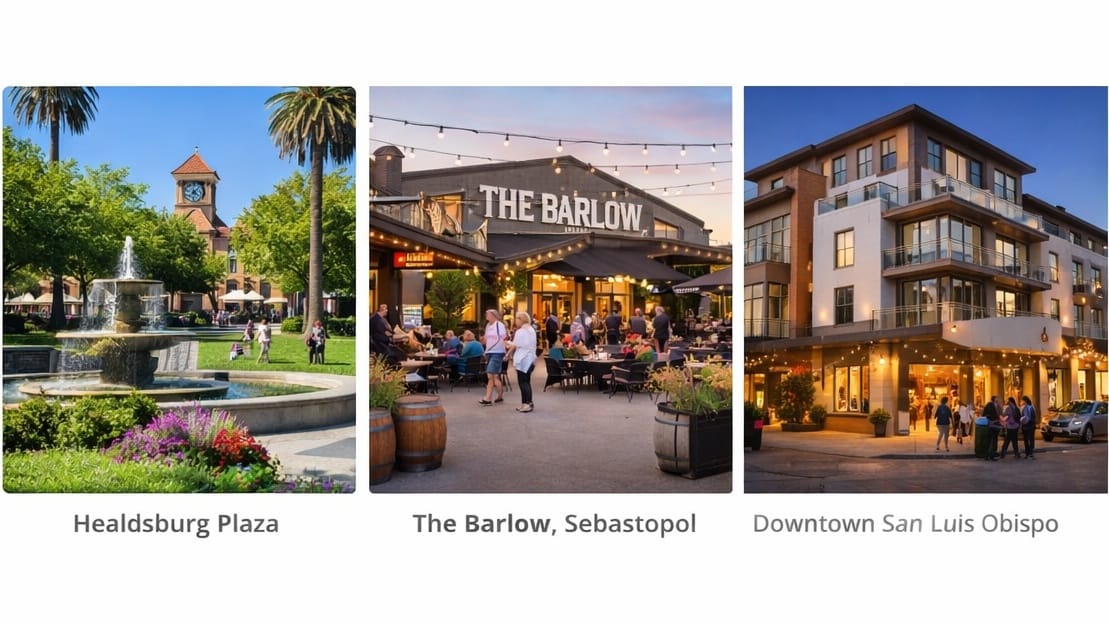
Healdsburg Plaza — Healdsburg, California (pop. ~11,000). A one-acre public park at the intersection of downtown's primary commercial streets, encircled by a ring road and shaded by redwoods. Land Econ Group's report describes how the town "prioritized preserving and beautifying the Plaza, which was a central square dating back to the late 19th century." The plaza hosts farmers markets, holiday festivals, and outdoor concerts. It generates no direct income. But with the plaza as focal point, "historic buildings surrounding the plaza were redeveloped into modern spaces to serve as boutique retail shops, tasting rooms, restaurants and art galleries." The 1907 Carnegie Library sits just off the plaza. Land Econ emphasizes that the Hotel Healdsburg — a luxury property built by the Piazza Hotel group in 2001 — "was instrumental in transforming the image of the town from a working-class community to an upscale wine country destination." That hotel anchors the plaza. The plaza anchors the town. Lodi has neither.
Downtown City Park — Paso Robles, California (pop. ~31,000). Five acres of land donated by the town's founders in 1890, centered around a gazebo and the 1908 Carnegie Library (now the Historical Society). The park hosts the annual Wine Festival, Olive & Lavender Festival, summer Concerts in the Park series, the annual Downtown Lighting Ceremony, and the weekly farmers market. The Paso Robles Downtown Main Street Association, operating for over 35 years, has earned Main Street America accreditation and credits the park as the anchor that transformed downtown into a tourist destination. Land Econ's report notes the Association has "managed to maintain low vacancy rates, foster community spirit, and attract visitors to the downtown." Paso also has a 14,600-seat outdoor event center a mile north of downtown, awarded $1.4 million in 2020 for facility improvements — a parallel to what the Grape Bowl District could become. Paso Robles' population, agricultural identity, and economic profile are the closest parallels to Lodi of any community in this analysis.
Los Olivos — Santa Barbara County, California (pop. ~1,100). An unincorporated community that demonstrates what happens when wine tourism concentrates along a walkable commercial street without a formal plaza but with preserved historic character. Land Econ highlights how over 30 tasting rooms have clustered within a five-block stretch of Grand Avenue, and how the reinvestment in Mattei's Tavern — a historic stagecoach inn converted to a luxury hotel — has been instrumental in upgrading the town. The lesson for Lodi: adaptive reuse of a historic anchor property catalyzes surrounding investment. The post office at 120 S. School Street is Lodi's equivalent opportunity.
The Barlow — Sebastopol, California (pop. ~7,400). Land Econ describes this 12-acre artisan marketplace as "a heritage themed mixed-use center to promote food, beverage, local wine, beer, and spirits, as well as local arts and crafts." Developer Barney Aldridge acquired the former apple canning site in 2005 and spent seven years transforming seven industrial buildings into 18 buildings with 50+ tenants. The Barlow was valued at approximately $42 million within three years of opening. Land Econ notes its key success factors: walkability, tasting rooms for local producers, artisan food operations, and — critically — gathering spaces that function as community commons. The Barlow demonstrates that a gathering space can be privately developed and income-generating while still functioning as a community living room.
Mission Plaza — San Luis Obispo, California (pop. ~47,000). Described by the city as its "most cherished and beloved civic space." The city is currently investing $5.8 million in a Mission Plaza Enhancement Project — café kiosk, interactive sculpture garden, improved restrooms, multiple gathering areas — because even a functioning, beloved plaza requires continued investment. Planning began in 2017; construction started in 2025. The lesson: cities treat their living rooms as permanent, evolving investments.
Sonoma Plaza — Sonoma, California (pop. ~11,000). Eight acres — the largest town square in California — designed in the 1830s by Mariano Vallejo. The plaza is the birthplace of the California wine industry and functions as both a historic landmark and a daily community gathering space surrounded by tasting rooms, restaurants, and boutique hotels. Despite being in a town of 11,000, the plaza anchors an economy supporting the Ledson Hotel, dozens of tasting rooms, and year-round visitor activity. Land Econ's comparison data shows Sonoma's median home value at $924,700 versus Lodi's $439,400 — the economic premium that a functioning downtown with a civic center commands.
Arcata Plaza — Arcata, California (pop. ~18,000). A classic town square bordered on four sides by two-story commercial buildings. The plaza hosts a weekly farmers market, chalk art festivals, and daily community gathering. Arcata's plaza-centered downtown thrives despite being in a remote Humboldt County location — evidence that the gathering space itself, not just favorable geography or proximity to major markets, drives the economic engine.
The pattern is consistent across every example: the gathering space was either inherited from the town's founding (Paso Robles, Healdsburg, Sonoma, Arcata) or deliberately created through public or private investment (SLO Mission Plaza, the Barlow). In no case did a comparable wine country downtown achieve Stages 5–8 without one. Lodi is attempting to reach those stages without the one asset every successful peer possesses.
How Lodi Compares: The Numbers
Land Econ Group's comparison of Lodi to other wine tourism cities in California reveals the gap between Lodi's potential and its current realization:
| Metric | Lodi | Paso Robles | Healdsburg | Sonoma | Sebastopol | St. Helena |
|---|---|---|---|---|---|---|
| Population (2023) | 67,679 | 31,134 | 11,137 | 10,619 | 7,380 | 5,272 |
| Median Household Income | $78,468 | $83,948 | $94,799 | $96,090 | $98,185 | $135,781 |
| Median Home Value | $439,400 | $620,300 | $933,400 | $924,700 | $824,400 | $1,631,700 |
| Retail Sales Per Capita | $19,348 | $21,277 | $30,282 | $23,745 | $25,531 | $29,554 |
Lodi is six times the population of Healdsburg, twice the population of Paso Robles, and has substantially lower incomes, home values, and retail sales per capita. This is not a weakness — it is the opportunity. Lodi has the market scale to support a downtown transformation that smaller communities achieved with far fewer residents. What it lacks is the catalyst infrastructure that unlocked that potential in every comparable case.
What the 1995 Plan Built — and What It Didn't
The 1995 Central City Revitalization Concept Plan, developed by Freedman, Tung & Bottomley and adopted unanimously by the Lodi City Council, identified School Street as downtown's primary spine. The plan's catalyst project — the School Street Gateway Arch and streetscape, completed in 1997 by Diede Construction — created the physical infrastructure that enabled Stages 1 and 2: old-fashioned brick streets, golden inlaid sidewalks, informational kiosks, a 30-foot Gateway Arch at School and Lodi Avenue, and thirty-foot Sycamores lining the corridor. The Sacramento Street Streetscape extension followed in 2014 with $1.2 million in additional investment.
The 1995 plan created corridors — places to walk. It created identity — a front door that announced downtown's presence. What it did not create was a destination — a place to stop and stay. It built the streets of the living room but not the living room itself.
The DTSP should be understood as the successor to the 1995 plan. The central gathering space is its catalyst project — just as the Gateway Arch was the 1995 plan's catalyst project. The 30-year investment in School Street has created the spine. The living room completes the circuit.
Part Two: The Site
Why Post Office Plaza
Post Office Plaza, at 120 S. School Street, is the highest-probability location for Lodi's central gathering space. Four lines of evidence converge.
1. Strategic Position. The site sits on School Street, the north-south spine the 1995 plan identified and the city has invested millions to transform. It is central within the DTSP plan area. Any investment here benefits from — and reinforces — thirty years of prior public infrastructure investment.
2. Historic Character. The post office building was constructed by the Treasury Department in 1935–1936 as a Works Progress Administration project — the same WPA program that built the Grape Bowl, the National Guard Armory, and other Lodi landmarks in that era. The building is one of downtown's most architecturally distinctive structures, with a civic presence that predates the wine country identity. Like the Carnegie Libraries that anchor the plazas of Paso Robles and Healdsburg, the WPA-era post office provides the kind of historic gravitas that purpose-built construction cannot replicate.
3. Organic Community Activation. The community has already claimed Post Office Plaza as its de facto gathering space — without any designed infrastructure. The Downtown Lodi Business Alliance programs Shop Sunday live music, holiday events with Santa's Village, and seasonal community programming on the site. The Business Alliance has actively advocated for cleanup and improvement with the Postmaster General. This behavioral evidence is the strongest possible case for the site's potential. People are gathering here despite the space's limitations, not because of its design.
4. The 2020 Signal — and a Conversation Worth Restarting.
In November 2020, Pacific Development Group — a third-generation, Lodi-headquartered firm founded in 1969 with a portfolio spanning several hundred transactions and management of over 5,000 housing units — approached city staff with a proposal to relocate the post office, retain the historic WPA building as a hotel lobby, and construct a new hotel and parking garage on the site.
Two facts from the 2020 proposal matter enormously for the current analysis.
First, the U.S. Postal Service signaled openness to relocation. The staff report indicated the post office was open to discussing the idea, contingent on city support as an economic development project. USPS almost never initiates this kind of willingness. They typically resist relocation fiercely. Lodi's post office said "we're listening" — an extraordinary signal.
Second, an experienced local developer independently identified this as downtown's highest-leverage opportunity— without a consultant study, without a specific plan, and without prompting. The market signal and the civic signal aligned.
The conversation stalled after November 2020. The likely factors — COVID-era hospitality market collapse, no identified USPS relocation site, and no planning framework to guide next steps — are understandable. But collectively, they represent a missed opportunity to sustain a conversation that had real momentum.
The DTSP changes the landscape. For the first time, the city has the planning framework that didn't exist in 2020 — the policy foundation, the market analysis, and the public engagement process to approach this opportunity with preparation rather than improvisation. The DTSP is the city's opportunity to be prepared this time.
Land Econ Group Validated the Location
Land Econ Group's December 2025 prototype feasibility analysis — the second document within Appendix 2 — adds significant validation. Their Priority Two project is a 60-room wine country hotel on two parcels at Sacramento and Walnut Streets, directly adjacent to the post office site. They recommend the hotel include "a high-end restaurant" and that the city "aggressively push this project forward" with development fee rebates recoverable through TOT collections within three to four years.
Land Econ found the right location and confirmed the hotel economics work. They recommend the city protect these parcels for future hotel development through specific hotel zoning or outright acquisition, even if a competing 150-room hotel project proceeds elsewhere downtown. Their language is worth noting: "RRM has found a well located and workable hotel site, and this site opportunity should be protected to achieve one of the City's key objectives."
This analysis proposes building on Land Econ's work by connecting their hotel opportunity to the gathering space opportunity and the USPS relocation opportunity — three elements that become far more powerful together than any one alone. A 60-room boutique hotel with its lobby in an adaptively reused WPA building, facing a public plaza on School Street, with direct Sacramento Street frontage — that is the catalyst project that combines everything Land Econ Group recommends into a single, integrated vision.
Part Three: Comparable Living Rooms — What They Tell Us About Implementation
The comparable gathering spaces examined in Part One suggest three implementation models, each with distinct implications for Lodi.
Model A — Municipal Civic Space (Healdsburg Plaza, Mission Plaza, Paso Robles City Park, Sonoma Plaza, Arcata Plaza)
The city owns and maintains the gathering space. No direct income generation; enormous indirect value through property appreciation, increased TOT, retail leasing premiums, and enhanced quality of life. Funded through general fund, grants, bonds, or dedicated revenue.
San Luis Obispo's $5.8 million Mission Plaza Enhancement Project demonstrates the ongoing investment required. Paso Robles' park was donated by town founders — no acquisition cost — but requires annual programming and maintenance investment. These are permanent public assets requiring permanent public commitment.
Model B — Private Developer Marketplace (The Barlow)
A private developer acquires the site, creates an artisan marketplace with publicly accessible gathering spaces. The developer bears risk and captures return through tenant leases. Public benefit comes through activated space, not public ownership. The Barlow's $42 million valuation demonstrates the private return potential, but the model requires sufficient site area (the Barlow's 12.5 acres vs. Post Office Plaza's approximately 1.7 acres) and a developer willing to prioritize placemaking alongside profit. Land Econ notes the Barlow took seven years from acquisition to ground-breaking — patience and community partnership were essential.
Model C — Public-Private Hybrid
The city supports USPS relocation and provides development incentives. A private developer converts the historic building and constructs complementary new development. The development agreement requires a public gathering space component as a condition of entitlement. The community gets both a hospitality anchor and a living room. This is where the 2020 PDG proposal was headed — but without a planning framework, a relocation strategy, or sustained city leadership.
For Lodi's current position, Model C is the highest-leverage play. It accomplishes both catalyst functions — hospitality anchor and gathering space — with a single project, uses private capital rather than straining city resources, and has an existing developer who already signaled interest. Land Econ Group's feasibility analysis confirms that a 60-room wine country hotel on this block is financially viable. Model C requires something the city did not have in 2020 and must build now: a DTSP that explicitly designates the site, protects the public space requirement, and provides development incentives; and a credible USPS relocation plan that gives the federal government confidence the city is serious.
Part Four: USPS Relocation as a Second Catalyst
The 2020 proposal's most significant gap was the absence of a specific USPS relocation site. This analysis proposes treating relocation not as a logistical afterthought but as a strategic opportunity — a two-for-one play that simultaneously frees Post Office Plaza for downtown activation and catalyzes development in a part of the city that multiple planning processes have already targeted for investment.
The Core Idea
A post office is a daily-traffic institutional anchor. Residents visit it regularly. Carriers stage from it daily. It generates consistent foot traffic at predictable hours. Placing it strategically can anchor an emerging district the same way a library, community center, or transit station catalyzes surrounding development.
The question for Lodi isn't just whether to relocate the post office — it's where a relocation creates the most additional value. The east side of downtown, stretching from Main Street through the Grape Bowl area, is the area that the city's own planning documents most consistently identify as needing activation. Two corridors in particular stand out.
The Grape Bowl District
The blocks surrounding the Grape Bowl (221 Lawrence Avenue) and extending along Stockton Street and Washington Street represent an emerging civic and recreation node. City-owned and public facilities in the immediate area include the Grape Bowl itself (WPA-built 1940, 3,576-seat stadium with synthetic turf), Zupo Field, the American Legion Hall (reopening Spring 2026), the National Guard Armory (WPA-built 1936, transferring to city ownership), the Grape Festival Grounds, and Lawrence Park.
Four independent planning processes have identified this area as an opportunity. Visit Lodi's Sports Tourism Strategic Plan (September 2025) identified the Grape Bowl/Zupo Field area as a sports tourism destination. Mayor Bregman convened a Grape Bowl Committee in October 2025 for a 5–10 year revitalization vision. The EDSP Community Workshop (June 2025) recommended an arts and culture district from Sacramento Street to Stockton Street. And the DTSP itself identifies the area as within or adjacent to its plan boundaries.
A post office here would provide the daily foot traffic that transforms a collection of event venues into a functioning district — solving the fundamental problem of an area that sits empty between events.
This area's potential extends well beyond the post office question. The convergence of the sports tourism strategy, the Grape Bowl Committee's revitalization vision, the EDSP arts and culture corridor, and the transfer of the Armory to city ownership creates an opportunity for a coordinated Grape Bowl District activation strategy. The DTSP should call for this strategy as a distinct planning effort — bringing together the stakeholders who are already working on overlapping goals and giving them a shared framework.
The Main Street Corridor
Main Street between downtown and the Grape Bowl area is a transitional corridor with semi-industrial and mixed uses that the city has already identified for investment. The corridor connects the downtown core to the Grape Bowl District, and its redevelopment is central to the east-west connectivity goal that appeared consistently in the EDSP workshop findings.
A post office on Main Street would anchor the corridor's transition from industrial to mixed use, provide daily activity that supports the residential conversion already underway on adjacent parcels, and serve as a bridge between downtown and the emerging Grape Bowl District — giving both areas a reason to grow toward each other.
What Either Location Achieves
Regardless of which corridor is ultimately selected, relocating USPS operations to the east side would:
- Provide a daily-traffic institutional anchor that brings consistent foot traffic to an area currently activated only during events.
- Support the emerging sports tourism and arts/culture strategies by adding a civic use that signals municipal investment.
- Advance the EDSP's Sacramento-to-Stockton corridor by placing an institutional use that draws residents east.
- Connect east and west Lodi — a goal explicitly identified in the EDSP workshop — by giving east-side residents a civic destination and west-side residents a reason to cross the traditional boundary.
- Create development pressure on adjacent parcels. A functioning post office with daily visitor traffic makes surrounding properties more attractive for complementary uses — coffee, convenience retail, service businesses.
A detailed site evaluation — assessing USPS operational requirements, specific parcel suitability, and relative activation impact — is a recommended next step. The point of this analysis is not to prescribe a specific parcel but to establish the strategic principle: the post office relocation is an economic development tool, and the Grape Bowl District/Main Street corridor is where the city's own planning documents say that tool is most needed.
Part Five: Recommended Actions
This analysis recommends a focused set of near-term actions to advance both the Post Office Plaza opportunity and the broader activation of Lodi's east side.
Formalize the Lodi Living Room. Partner with the Downtown Lodi Business Alliance and community stakeholders to establish a "Lodi Living Room" initiative — whether as a pilot placemaking program, a public engagement campaign, or a formal community effort. The goal is to give the gathering space concept a name, a constituency, and visible momentum. Deploy low-cost placemaking elements at Post Office Plaza (movable seating, string lighting, planters, temporary shade) and program regular activation events to demonstrate demand and build the evidentiary case for permanent investment.
Incorporate catalyst site language into the DTSP. Before or during DTSP adoption (anticipated April 2026), advocate for explicit language identifying Post Office Plaza as a catalyst opportunity site, establishing development incentives (TOT rebates, parking credits, streamlined review), and requiring preservation of public gathering function as a condition of any future development.
Adopt a City Council resolution authorizing renewed USPS negotiations. Building on the 2020 letter of intent precedent, the City Council should formally authorize re-engagement. The resolution should reference the DTSP designation, demonstrated community interest, and the city's commitment to facilitating relocation to a specific identified area — not a vague promise to find one later.
Commission a dual-site feasibility study. A qualified firm should evaluate: (a) development scenarios for Post Office Plaza, building on Land Econ Group's prototype feasibility work, and (b) the Grape Bowl District/Main Street corridor's suitability as a USPS relocation site, including operational requirements assessment, specific parcel evaluation, preliminary site planning, and cost estimates.
Engage Visit Lodi, the Grape Bowl Committee, the Chamber of Commerce, and the EDSP process. Align the USPS relocation strategy with the Sports Tourism Strategic Plan, the Grape Bowl Committee's 5–10 year vision, and the Economic Development Strategic Plan. The post office relocation to the Grape Bowl District/Main Street corridor should be framed as an implementation action for all of these efforts — not a standalone real estate transaction.
Part Six: What the DTSP Should Include
This analysis recommends that the following elements be incorporated into the Downtown Specific Plan before or during the adoption process:
- Catalyst Site Designation. Explicitly identify Post Office Plaza as a priority catalyst opportunity site, referencing its strategic position, historic character, community activation history, and 2020 development interest.
- USPS Relocation Policy. Acknowledge the 2020 willingness signal and establish city policy supporting the relocation of downtown postal operations as an economic development priority.
- Public Gathering Space Requirement. For any development on the catalyst site, require preservation of public gathering function — minimum area, programming access, and design standards — as a condition of entitlement.
- Development Incentives. Establish incentives for catalyst site development: TOT rebates, parking requirement reductions (consistent with Land Econ Group's recommendation of one stall per unit for downtown multifamily), streamlined design review, and potential infrastructure contributions.
- Grape Bowl District Activation Strategy. Call for the development of a coordinated Grape Bowl District activation strategy that brings together the Sports Tourism Strategic Plan, the Grape Bowl Committee's 5–10 year vision, and EDSP arts/culture corridor recommendations into a unified framework. The Grape Bowl District has the concentration of public assets, community energy, and overlapping planning momentum to become Lodi's premier civic, sports, and cultural destination — but only if the efforts currently underway are connected rather than siloed.
- Lockeford Street Corridor Enhancement. Call for a future corridor design study for Lockeford Street as the primary east-west gateway connecting the downtown core to the Grape Bowl District. Lockeford is visible on the DTSP plan area map as a key cross-street, but it currently functions as a transition zone rather than an inviting connection. Reimagining Lockeford as a designed gateway — with streetscape improvements, wayfinding, and pedestrian-friendly design — would physically link the downtown investment to the east-side activation and make the Grape Bowl District feel like an extension of downtown rather than a separate destination.
- Green Line Connection to Lodi Lake. Call for a fresh evaluation of a greenway or trail connection between the downtown core and Lodi Lake. Lodi Lake is one of the city's most beloved natural assets, but it is functionally disconnected from downtown. A dedicated pedestrian and bicycle connection — a "Green Line" — would extend downtown's reach northward, create a recreational amenity that enhances downtown living, and give visitors a reason to experience Lodi beyond the tasting rooms and restaurants. The DTSP should identify this connection as a long-term priority and recommend a feasibility and alignment study.
- Activation Standards. Adopt development standards supporting outdoor dining, sidewalk activation, parklets, and public gathering uses throughout the plan area — the regulatory foundation for placemaking and long-term district vitality.
Conclusion: Completing the Work of 1995
Thirty years ago, the City of Lodi invested in a vision for its downtown. The 1995 plan created the physical infrastructure that enabled the hospitality investment and visitor traffic Lodi enjoys today. That plan worked.
The Downtown Specific Plan represents the next generation of that vision. The question before the city is the same question the 1995 plan answered: what is the catalyst investment that makes everything else possible?
In 1995, the answer was identity and movement — giving downtown a front door and a reason to walk in.
In 2026, the answer is gathering and permanence — giving downtown a living room and a reason to stay.
Every comparable wine country downtown that has achieved what the City Council's stretch goal describes — a lively, mixed-use, walkable district — did so with a central gathering space at its core. The city's own economic consultant names the pattern. The comparable communities demonstrate it. The market data supports it. An experienced local developer identified the specific site and surfaced USPS willingness to discuss it.
Multiple planning processes — the DTSP, the Sports Tourism Strategic Plan, the Grape Bowl Committee, and the Economic Development Strategic Plan — are all working toward goals that converge on the same geographic opportunities. This analysis attempts to connect the dots and suggest that coordinated action across these efforts would be more powerful than any one alone.
The DTSP should acknowledge the Post Office Plaza opportunity. The City Council should authorize the conversation to restart — and this time, sustain it. The USPS relocation should be treated as a second catalyst, activating the Grape Bowl District/Main Street corridor as part of a coordinated strategy that advances the sports tourism vision, the EDSP arts and culture corridor, and the connection between east and west Lodi. And the Grape Bowl District deserves its own activation strategy — one that brings together the stakeholders already working on overlapping goals and channels their energy into a shared framework.
The community should be invited to imagine what Lodi's living room could be — starting with a few chairs, some string lights, and the simple act of giving people a reason to stop and stay.
Sources and References
City of Lodi Official Documents
- City Council Strategic Vision (May 2023, reaffirmed January 28, 2026)
- Downtown Specific Plan — Public Review Draft (2025–2026), planlodi.com
- Land Econ Group, "Economics and Market Report for Downtown Lodi Specific Plan" (February 20, 2025) — DTSP Appendix 2
- Land Econ Group, "Evaluation of Financial Feasibility of Prototype Development Projects in Lodi Downtown Specific Plan Area" (December 4, 2025) — DTSP Appendix 2
- Economic Development Strategic Plan, Community Workshop Summary (June 16, 2025)
- City Council Meeting Agenda, November 18, 2020 — Pacific Development Group Letter of Intent
- Parks & Recreation Strategic Action Plan (January 2016)
Visit Lodi
- Sports Tourism Strategic Plan — Huddle Up Group partnership, presented to City Council September 2025
- Destination Master Plan (in development, 2025–2026)
- Visit Lodi Tourism Business Improvement District 2025 Annual Report and 2026 Plan
Historical References
- 1995 Central City Revitalization Concept Plan — Freedman, Tung & Bottomley
- School Street Gateway Arch and Streetscape (1997) — Diede Construction
- Sacramento Street Streetscape Extension (2014)
Grape Bowl District
- Grape Bowl Committee — convened October 2025, Mayor Cameron Bregman
- Lodi 411, "Lodi's Grape Bowl: History and Future Vision" (November 24, 2025)
- CBS Sacramento, "How Lodi is Looking to Bring More Sporting Events to Town" (February 12, 2025)
- Lodi News-Sentinel, "Are Lodi's Sporting Amenities Limiting City as a Tourist Destination?" (February 8, 2025)
- Lodi News-Sentinel, "If You Build It — or Renovate — Will They Come?" (September 6, 2025)
Comparable Communities
- San Luis Obispo Mission Plaza Enhancement Project ($5.8M, planning began 2017, construction 2025)
- Paso Robles Downtown Main Street Association
- Healdsburg Plaza and Hotel Healdsburg (Piazza Hotel Group, 2001)
- The Barlow, Sebastopol (Aldridge Development, 2005–2012)
This analysis was prepared by Inferterra as an independent contribution to the Downtown Specific Plan public review process. The author lives in Lodi and has a personal stake in the community's success.
If any part of this analysis is useful to your work — whether you're on City Council, the Planning Commission, a consultant team, a community organization, or a resident who cares about Lodi's future — I'd welcome the conversation. I'm open to helping push this forward in whatever way makes sense.
Matt Teresi
matt@inferterra.com
inferterra.com